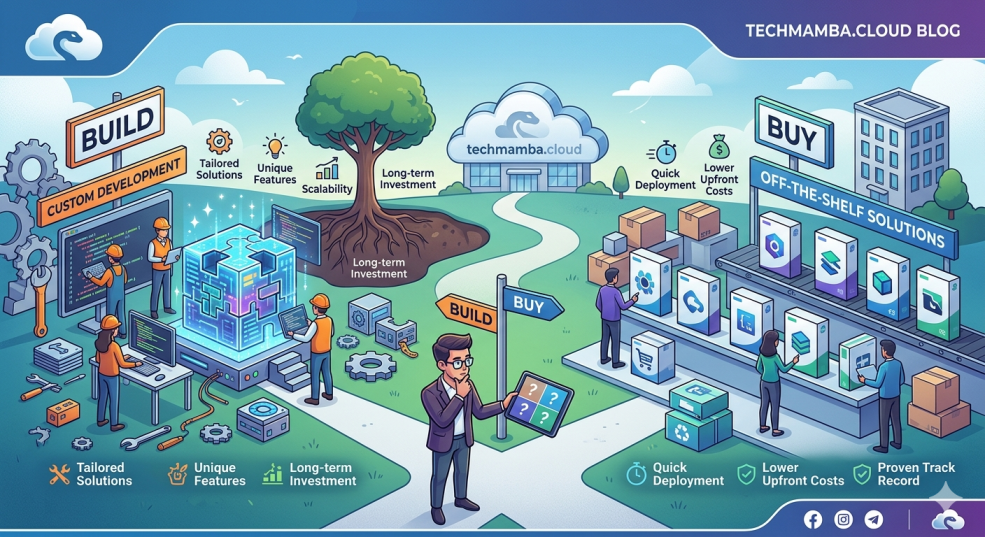
In today’s fast-moving digital economy, software is no longer just a support tool — it is often the foundation of how modern businesses operate, scale, and compete.
From customer management and automation to analytics, operations, and communication, businesses rely heavily on software to drive growth. But as companies evolve, many leaders face an important strategic question:
Should we continue buying off-the-shelf SaaS products, or is it time to build custom software tailored to our business?
At first, ready-made software solutions appear to be the perfect choice. They are quick to deploy, relatively affordable, and easy to implement. However, as businesses grow, many discover that generic platforms eventually create limitations instead of solving them.
Disconnected systems, rising subscription costs, integration problems, workflow restrictions, and lack of flexibility often become major operational challenges.
This is where custom software development becomes a competitive advantage.
The decision to build instead of buy is not simply a technical choice — it is a long-term business strategy that can directly impact scalability, efficiency, customer experience, and profitability.
In this guide, we’ll explore when businesses should invest in custom software development instead of relying entirely on SaaS platforms, and how to evaluate the right approach for sustainable growth.
The Real Problem With One-Size-Fits-All Software
Off-the-shelf software is designed for mass adoption. It works well for standardized business needs, but it is rarely optimized for the unique processes that define growing companies.
For example, imagine a logistics startup using a SaaS route-planning platform. Initially, the software performs well enough. But as the company expands, it needs:
-
integration with multiple carrier systems,
-
custom pricing algorithms,
-
real-time analytics,
-
and specialized reporting dashboards.
Suddenly, the platform’s limitations become obvious.
The business now relies on:
-
manual workarounds,
-
disconnected tools,
-
expensive integrations,
-
and vendor-controlled feature updates.
This situation is common across industries including:
-
healthcare,
-
finance,
-
logistics,
-
manufacturing,
-
legal services,
-
eCommerce,
-
and SaaS startups.
The issue is not that SaaS products are bad. In fact, many are excellent solutions for standard business operations.
The problem arises when businesses outgrow software built for the average user.
When Should Your Business Build Instead of Buy?
Not every company needs custom software immediately. However, there are several clear signs that indicate when building a custom solution becomes the smarter long-term investment.
1. Your Software Is Part of Your Competitive Advantage
If technology directly impacts your customer experience or operational efficiency, relying entirely on generic tools can limit innovation.
Businesses today increasingly compete through:
-
automation,
-
speed,
-
user experience,
-
data insights,
-
and operational efficiency.
For example:
-
A delivery company may depend on advanced route optimization.
-
A marketing agency may require custom campaign automation.
-
A healthcare provider may need specialized patient workflows.
-
A SaaS startup may require proprietary analytics systems.
When software becomes central to your business model, owning the platform provides significantly greater strategic control.
Custom software allows companies to:
-
build unique features,
-
automate specialized processes,
-
scale operations efficiently,
-
and innovate faster than competitors using the same off-the-shelf tools.
In many industries, custom technology becomes a true business differentiator.
2. You’re Managing Too Many Disconnected Systems
Many growing businesses rely on multiple platforms for daily operations, including:
-
CRM software,
-
email marketing tools,
-
analytics dashboards,
-
inventory systems,
-
support platforms,
-
and project management software.
Initially, this setup works. But over time, teams begin struggling with:
-
duplicate data,
-
inconsistent reporting,
-
manual data transfers,
-
integration failures,
-
and workflow inefficiencies.
As operational complexity grows, productivity often decreases.
Custom software development allows businesses to centralize operations into a unified platform tailored specifically to their workflow.
Instead of forcing employees to adapt around multiple disconnected systems, the software adapts to how the business actually operates.
This often results in:
-
improved efficiency,
-
reduced operational overhead,
-
faster decision-making,
-
and better team collaboration.
3. Subscription Costs Keep Increasing
One of the biggest hidden challenges with SaaS platforms is scalability pricing.
Most software providers charge businesses for:
-
additional users,
-
premium integrations,
-
advanced automation,
-
API access,
-
storage,
-
and enterprise-level features.
At first, these costs seem manageable. But as businesses scale, monthly subscriptions can become a major recurring expense.
Many organizations eventually discover they are paying thousands of dollars every month across multiple software platforms that still fail to fully meet their requirements.
Custom software development typically requires a higher upfront investment, but it can significantly reduce long-term operational costs while providing full ownership and flexibility.
Instead of continuously paying for software limitations, businesses invest in technology designed specifically around their goals.
4. Your Business Requires Complex Integrations
Modern businesses often rely on multiple systems working together in real time.
This may include:
-
ERP systems,
-
payment gateways,
-
IoT devices,
-
AI services,
-
legacy databases,
-
logistics APIs,
-
and analytics platforms.
Unfortunately, many SaaS products only support basic integrations.
Anything beyond standard use cases often requires:
-
expensive middleware,
-
third-party connectors,
-
or manual processes.
Custom software development allows businesses to create:
-
stable integrations,
-
real-time synchronization,
-
automated workflows,
-
and scalable architecture tailored to their ecosystem.
This becomes especially valuable for businesses operating at scale or handling high volumes of data.
5. Security and Compliance Are Critical
For businesses handling sensitive data, security and compliance are major concerns.
Industries such as:
-
healthcare,
-
finance,
-
legal services,
-
and enterprise SaaS
often require strict control over:
-
data access,
-
audit logs,
-
encryption,
-
infrastructure,
-
and regulatory compliance.
While SaaS platforms offer security features, businesses still depend heavily on third-party vendors for data protection and compliance standards.
Custom software provides greater control through:
-
role-based access systems,
-
custom security protocols,
-
compliance-focused architecture,
-
infrastructure flexibility,
-
and advanced monitoring.
For organizations with strict regulatory requirements, custom software can provide stronger long-term security and operational confidence.
A Simple Framework: Build vs Buy
Businesses can evaluate whether to build or buy software using five key factors.
Strategic Differentiation
Does the software directly impact your competitive advantage?
If yes, custom software may provide stronger long-term value.
Integration Complexity
How many systems need to work together?
The more complex your ecosystem becomes, the more valuable custom architecture becomes.
Total Cost of Ownership
What will the software realistically cost over the next 3–5 years?
Consider:
-
subscriptions,
-
integrations,
-
maintenance,
-
operational inefficiencies,
-
and scalability costs.
Speed vs Flexibility
Do you need rapid deployment, or long-term adaptability?
SaaS platforms provide faster implementation, while custom software offers greater long-term flexibility and control.
Security & Compliance
Does your industry require strict control over data and infrastructure?
If yes, custom software often becomes the safer strategic investment.
When Buying Software Still Makes Sense
Custom software is powerful, but it is not always necessary.
Buying existing software is often the better option when:
-
the requirement is standardized,
-
time-to-market is urgent,
-
or the functionality is not strategically important.
For example:
-
accounting software,
-
payroll systems,
-
HR tools,
-
and communication platforms
usually do not require custom development unless businesses have highly specialized workflows.
The goal is not to build everything.
The goal is to build the systems that create measurable business value.
The Long-Term Advantage of Custom Software Development
Businesses that invest in the right custom software solutions often gain advantages far beyond technology itself.
These benefits include:
-
operational efficiency,
-
improved automation,
-
scalability,
-
reduced vendor dependency,
-
better customer experiences,
-
and stronger competitive positioning.
Most importantly, custom software evolves alongside the business.
Instead of adapting your company around software limitations, your software adapts around your growth strategy.
That flexibility becomes increasingly valuable as markets evolve and customer expectations continue to rise.
Final Thoughts
Choosing between SaaS and custom software development is ultimately a business decision — not just a technical one.
Off-the-shelf software works well for speed and standardization. But when businesses require scalability, operational flexibility, complex integrations, security, and competitive differentiation, custom software development often becomes the smarter long-term investment.
The companies that scale successfully are usually the ones that treat technology as a strategic asset rather than simply an operational expense.
If your business is starting to feel constrained by disconnected systems, rising subscription costs, or software limitations, it may be time to explore a custom solution designed specifically around your goals.
The right software should not force your business to adapt.
It should help your business grow.
Ready to Build Software Tailored to Your Business?
At TechMamba Cloud, we help startups and enterprises build scalable, secure, and high-performance custom software solutions designed around real business goals.
Whether you need:
-
a SaaS platform,
-
business automation software,
-
CRM development,
-
AI-powered applications,
-
or enterprise software solutions,
our team can help you design and develop software built for long-term success.
Contact TechMamba Cloud today to discuss your custom software project.