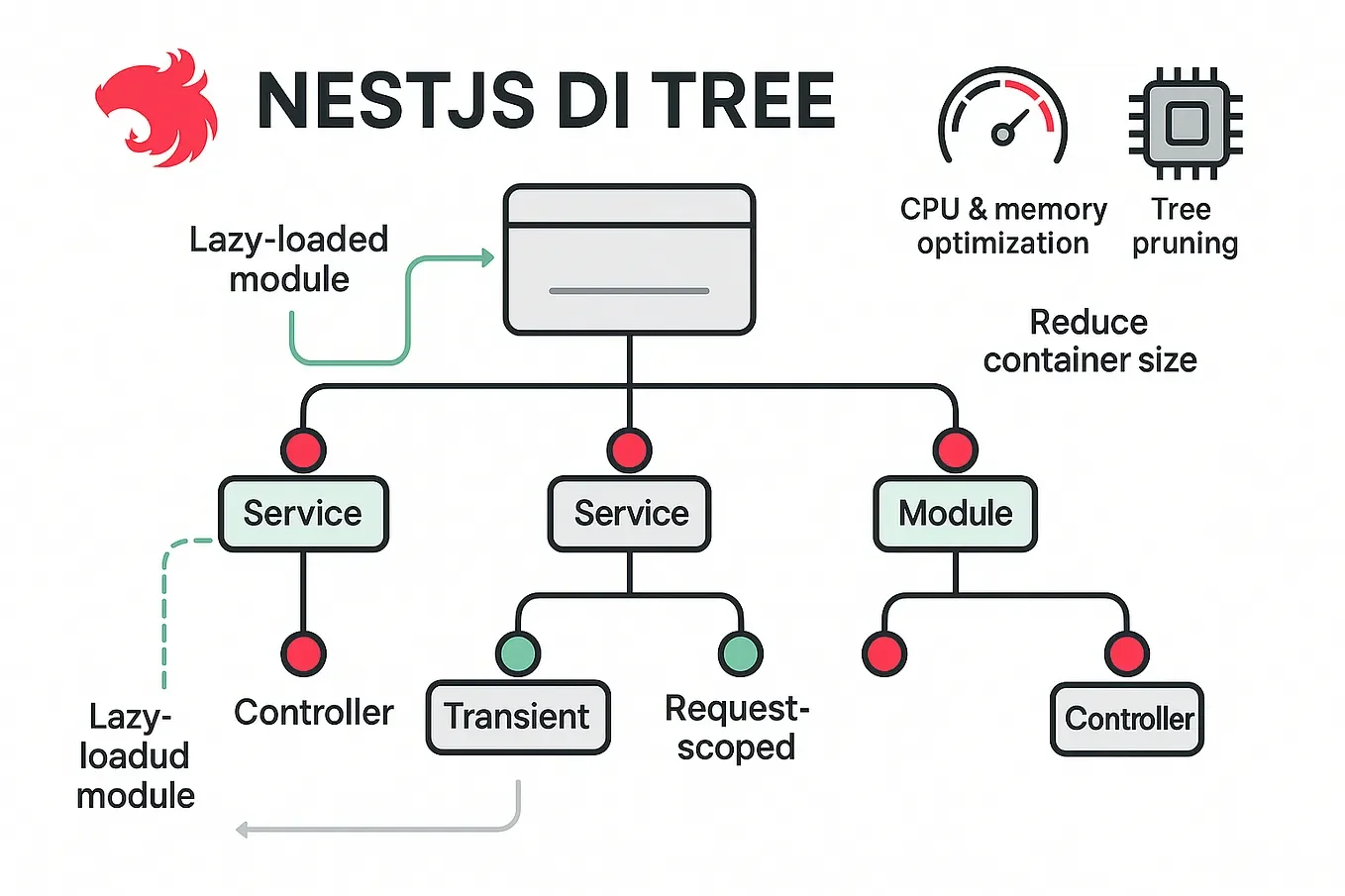
The High-Throughput Challenge: Navigating Peak Architectural Stress
Imagine a high-volume fintech platform during the market opening bell. Tens of thousands of concurrent clients execute buy and sell orders, refresh portfolio balances, and query historical tickers simultaneously. In a poorly structured Node.js system built on top of raw Express scripts, this massive spike quickly degrades performance. Unhandled promises pool up, uncaught database connection failures cascade across the system, and developers struggle to debug which specific route is consuming available memory. The application eventually crashes under the weight of its own unstructured design, causing significant financial exposure.
[ Chaotic Express App ] ── Spikes in Event Loop ──► [ Uncaught Exception Cascades ] ──► System Crash
  vs.
[ Hardened NestJS App ] ── Decoupled Architecture ──► [ Request-Response Sandboxing ] ──► 99.99% Uptime
This scenario highlights why modern enterprise architectures require absolute predictability, testability, and clean separation of concerns. The common industry mistake is viewing backend development as simply stitching together disparate npm packages with loose mid-layer code. Without strict engineering guidelines, JavaScript backends quickly become difficult to maintain and scale. This whitepaper explains how to build production-grade, highly scalable REST APIs using NestJS. You will learn how to leverage its architectural patterns, dependency injection mechanisms, and performance profiling strategies to maintain high availability and sub-30ms execution windows under heavy enterprise traffic.
The Core Paradigm: Understanding Structural Predictability
At its core, a scalable NestJS application relies on the principle of Inversion of Control (IoC), achieved through a highly structured, modular system design. Instead of forcing developers to manually instantiate classes and handle nested file imports, NestJS uses an explicit declaration design that defines clear entry points, controllers, and domain services.
From an engineering perspective, this shifts focus away from managing file import paths and toward building well-defined system contracts. The framework acts as an intelligent coordinator, building an internal dependency graph at startup to ensure every service is instantiated once, memory usage is optimized, and resource allocations are locked in before the system begins accepting public traffic.
Architectural Diagram Overview
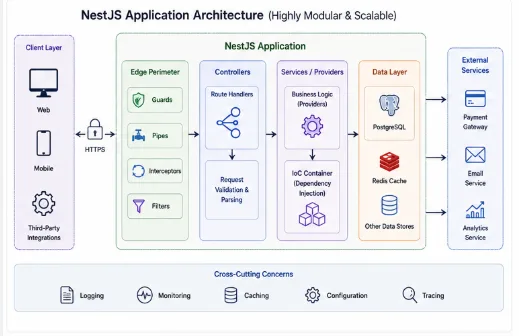
The architecture organizes incoming client network traffic into isolated request-response sandboxes. It routes requests through strict, layer-by-layer filters before reaching your core domain databases, ensuring malicious inputs are caught at the perimeter.
[ Inbound Network Requests ]
            │
            ▼
┌──────────────────────────────────────┐
│       NestJS Edge Perimeter          │
│  (Guards, Interceptors, Filters)     │
└──────────────────────────────────────┘
            │
            ▼
┌──────────────────────────────────────┐
│      Controller Route Handlers       │
│  (Payload Validation & Parsing)      │
└──────────────────────────────────────┘
            │
            ▼
┌──────────────────────────────────────┐
│       Inversion of Control (IoC)     │
│  (Isolated Domain Modules & Services)│
└──────────────────────────────────────┘
            │
            ▼
┌──────────────────────────────────────┐
│        Persistent Storage Layer      │
│  (PostgreSQL, Redis Cache Buffers)  │
└──────────────────────────────────────┘
The Logistics Hub Analogy
Think of this structured layout like a modern international airport logistics hub. In an un-architected backend, packages are dropped into a single giant warehouse floor with no labeling. Workers run around looking for specific boxes, frequently bumping into each other and dropping packages, slowing down the entire operation.
A scalable NestJS architecture operates like an automated sortation facility. Packages arrive at designated loading bays (Controllers). Automated scanning machines verify customs clearance declarations (Guards) and fix labeling errors (Interceptors) before sorting items. The packages then travel down dedicated conveyor belts to specialized handling teams (Services) who place them into secure vaults (Databases). If the electronics team experiences a backlog, the apparel sortation line continues running at full capacity without delay.
Deep Technical Explanation: Deconstructing the Core Subsystems
Operating resilient distributed APIs requires analyzing the internal mechanics of individual framework building blocks. Let's break down the six core layers that make up a production-grade NestJS runtime.
Controller Routers
Controllers serve as the entry point for all incoming HTTP requests, mapping specific URL endpoints and request methods directly to underlying execution functions.
Their primary purpose is to decouple network protocol details from your core business logic. They ingest public payloads, extract route parameters, manage status codes, and handle response serialization.
Internally, NestJS maps these metadata definitions using TypeScript decorators. When the application boots, the routing engine registers these configurations into a fast lookup table. Incoming requests match this table instantly, routing traffic to the correct controller function without needing to iterate through long lists of manual conditional routes.
-
Advantages: Centralizes route management, simplifies testing via mock HTTP decorators, and cleanly isolates network protocols from domain services.
-
Limitations: Placing complex validation logic inside controllers can quickly bloat file sizes and blur the boundary between network handling and business logic.
-
Engineering Note: Keep controllers highly lightweight. They should only validate basic input shapes and hand payloads off to the service tier immediately.
Providers and Domain Services
Providers form the foundation of the NestJS ecosystem. Almost any core class—such as services, data repositories, or factory utilities—can be treated as a provider that is automatically instantiated and managed by the IoC container.
Their primary purpose is to encapsulate specific business logic domains, such as processing a payment or calculating an inventory balance.
┌────────────────────────────────┐
│   NestJS IoC Container         │
│  ┌──────────────────────────┐  │
│  │ Instantiates Provider    │  │
│  └────────────┬─────────────┘  │
└───────────────┼────────────────┘
                ▼
┌────────────────────────────────┐
│  Injects Cache Dependency      │
└────────────────────────────────┘
When a controller declares a service dependency inside its constructor, the NestJS framework checks its internal dependency tree. If the service instance already exists, it injects the existing reference directly. If it doesn't, NestJS creates the instance, resolves any dependencies that service needs, and stores it in memory for future lookups.
-
Advantages: Eliminates manual class instantiation boilerplate, simplifies unit testing via easy dependency mocking, and optimizes memory usage by defaulting to singletons.
-
Limitations: Dynamic provider configurations can increase application startup times and make debugging dependency resolution bugs more complex.
-
Engineering Note: Avoid using request-scoped providers unless absolutely necessary. Creating fresh provider instances for every request introduces substantial garbage collection overhead under heavy traffic.
Domain Modules
Modules are organized structural blocks defined using the @Module() decorator. They group together related controllers and providers into clean, well-defined architectural boundaries.
Their primary purpose is to build clear encasing boundaries around specific business contexts, ensuring modules only expose explicit interfaces to the rest of the application.
Internally, NestJS reads these module metadata objects to construct its runtime execution tree. Providers listed in the providers array stay private to that specific module by default. To share a utility across the app, a module must explicitly list it in its exports array, forcing developers to design intentional, well-structured communication paths between different systems.
-
Advantages: Promotes clean domain separation, supports lazy-loading modules to optimize memory, and makes it easy to package features into reusable libraries.
-
Limitations: Careless module nesting can lead to circular dependency errors that crash the application during compilation.
-
Engineering Note: Design modules around specific business subdomains rather than technical layers. For example, use a unified
WalletModuleinstead of creating generic, app-wideServicesModuleorControllersModulefiles.
Security Guards
Guards execute immediately after the routing engine matches an incoming request, evaluating configuration conditions before allowing traffic to reach the controller layer.
Their primary purpose is to protect your application perimeter by handling security logic like authentication verification, API rate-limiting, and Role-Based Access Control (RBAC).
Unlike traditional Express middleware which handles authentication via generic callback chains, NestJS Guards have full access to the ExecutionContext pipeline. This means a guard can inspect the target route's custom metadata tokens to determine exactly what permission levels or scopes are required before letting the request pass.
-
Advantages: Prevents unauthorized requests from hitting expensive business logic, simplifies testing by isolating security code, and provides access to advanced route metadata.
-
Limitations: Making slow, synchronous database calls inside a guard will quickly create network bottlenecks and slow down public routes.
-
Engineering Note: Use fast, in-memory cache lookups (like Redis clusters) inside your guards to verify session flags and user permission status.
Data Interceptors
Interceptors are powerful mid-layer tools that wrap the entire request-response lifecycle, allowing you to run custom logic both before a route handler executes and after it returns.
Their primary purpose is to apply global performance optimizations and data transformations across the application. They handle tasks like caching responses, logging request times, and sanitizing output payloads.
Interceptors use reactive streams built on top of RxJS observables. When a controller function completes, the interceptor intercepts the outgoing data stream, transforming the payload or caching the results before sending the final HTTP response back down the network pipe.
-
Advantages: Eliminates boilerplate code by centralizing data formatting, supports asynchronous response overrides, and provides precise execution timing metrics.
-
Limitations: Overusing complex RxJS stream transformations can easily introduce memory leaks and increase CPU usage if not managed carefully.
-
Engineering Note: Use interceptors to strip private fields or sensitive user keys from outbound payloads globally, ensuring your API never accidentally leaks internal data.
Exception Filters
Exception Filters serve as the final safety net for your application, catching any unhandled errors thrown during the request-response lifecycle.
Their primary purpose is to prevent raw runtime errors from crashing the Node.js process, converting unhandled exceptions into clean, standardized client error payloads.
┌────────────────────────────────┐
│ Unhandled Controller Error     │
└───────────────┬────────────────┘
                ▼
┌────────────────────────────────┐
│ Exception Filter Interception  │
└───────────────┬────────────────┘
                ▼
┌────────────────────────────────┐
│  Standardized JSON Error Sent  │
└────────────────────────────────┘
When an exception occurs anywhere in the execution chain, the framework stops standard processing and routes the error down to the matching exception filter. The filter inspects the exception type, logs the stack trace to your monitoring systems, and structures a predictable JSON error response for the client.
-
Advantages: Guarantees your API always returns consistent error shapes, prevents raw database errors from leaking to the public, and centralizes system error logging.
-
Limitations: If you configure a generic, catch-all filter incorrectly, you run the risk of silencing critical system errors that should be causing immediate health-check alerts.
-
Engineering Note: Always build a fallback catch-all exception filter to ensure your API consistently returns standard error payloads, even when unexpected system exceptions occur.
Core Patterns: Implementing Resilient System Topologies
Structuring enterprise architectures requires applying robust patterns that ensure code maintainability, data security, and performance stability at scale.
Encapsulated Domain Modules
This pattern groups all related controllers, services, and data repositories for a single business feature into one highly isolated module boundary.
┌────────────────────────────────────────────────────────┐
│                      BillingModule                     │
│ ┌──────────────────┐ ┌────────────────┐ ┌────────────┐ │
│ │ BillingController│ │ BillingService │ │ BillingRepo│ │
│ └──────────────────┘ └────────────────┘ └────────────┘ │
└────────────────────────────────────────────────────────┘
By grouping all financial components inside a single BillingModule, you ensure the billing service remains completely private to its domain. If the inventory system needs to process a charge, it cannot query the billing tables directly or call private internal functions. Instead, it must interact with the explicit interface exposed by the BillingModule exports array.
This approach creates highly maintainable codebases where individual features can be updated or refactored without causing unintended bugs across the rest of the application. The trade-off is the extra initial work required to plan clean module boundaries and build shared interface contracts. This pattern is essential for large, team-driven projects, but is unnecessary for tiny, single-file prototypes.
Global Exception Interception and Filtering
This pattern deploys an application-wide safety net that intercepts all unhandled errors, formats them into a predictable JSON structure, and logs the details to your monitoring infrastructure.
When a database connection drops unexpectedly during a user request, the database driver throws a raw error string. Instead of letting this unhandled error crash the application server or leak internal database credentials to the public, the global exception filter catches it, logs the full trace to your internal monitors, and returns a clean, secure 500 Internal Server Error message to the client.
This guarantees your API always presents a reliable, professional contract to external clients while keeping internal infrastructure details safe. The trade-off is that it requires developers to use structured, framework-specific exception classes throughout the codebase. It is highly recommended for all public-facing production APIs, but is less critical for internal development tools.
Inversion of Control with Dynamic Providers
This pattern uses the IoC container to dynamically switch between different concrete class implementations at runtime based on configuration environments or injection tokens.
                  ┌───────────────────────┐
                  │ Injection Token: CACHE│
                  └───────────┬───────────┘
                              ▼
                ┌──────────────────────────┐
                │   NestJS IoC Container   │
                └──────┬────────────┬──────┘
       Production Mode │            │ Development Mode
                       ▼            ▼
          ┌───────────────┐      ┌───────────────┐
          │ RedisProvider │      │InMemProvider  │
          └───────────────┘      └───────────────┘
Instead of hardcoding a direct connection to a specific database client inside your service code, you inject a generic interface token like CACHE_PROVIDER. When the application boots, NestJS reads your current environment flags. In production, it injects a high-performance Redis cluster provider, while in local development, it injects a lightweight, in-memory array provider instead.
This abstraction makes your core business logic incredibly flexible and easy to test, since you can swap out heavy infrastructure components for lightweight mocks instantly. The trade-off is the added mental overhead needed to manage dynamic config factories and injection token names. This pattern is ideal for multi-tenant SaaS backends, but is over-engineered for simple applications that use a single database stack.
Context-Aware Interception Filtering
This pattern uses NestJS interceptors to dynamically modify inbound request parameters or transform outbound data payloads based on the current execution route's metadata tags.
When a client queries an account profile endpoint, the request passes through a global serialization interceptor. The interceptor reads the target route's custom metadata tags, identifies the user's role, and dynamically strips out sensitive fields—such as password hashes or private internal IDs—before sending the data down the wire.
This approach eliminates the need to manually write field sanitization logic inside every single route handler, reducing code duplication and preventing accidental data leaks. The trade-off is the extra CPU processing power required to parse and transform large data arrays on the fly. It is a fantastic choice for building clean, secure open-data APIs, but should be used sparingly on ultra-low-latency data streaming endpoints.
Technical Blueprint: Production-Grade Custom Metadata and Interceptor Fabric
The following blueprint provides a production-ready system orchestration engine written in Python. It models the core request pipeline behaviors of a high-performance NestJS platform: parsing input metadata tokens, enforcing secure execution parameters, tracking processing latency, and transforming payload structures dynamically.
import os
import sys
import time
import functools
import json
import logging
from typing import Dict, Any, Callable, Tuple, List, Optional

# Configure robust production logging output
logging.basicConfig(
    level=logging.INFO,
    format="%(asctime)s [%(levelname)s] %(name)s - %(message)s",
    stream=sys.stdout
)
logger = logging.getLogger("NestJSExecutionFabric")

class ExecutionContext:
    """
    Simulates the NestJS ExecutionContext wrapper.
    Provides deep inspection flags for the current route metadata array.
    """
    def __init__(self, target_route: str, method: str, headers: Dict[str, str], payload: Dict[str, Any]):
        self.target_route = target_route
        self.method = method
        self.headers = headers
        self.payload = payload
        self.metadata_store: Dict[str, Any] = {}

    def get_handler_metadata(self, key: str) -> Optional[Any]:
        """Retrieves custom metadata attributes bound to the execution thread."""
        return self.metadata_store.get(key)

    def set_handler_metadata(self, key: str, value: Any) -> None:
        """Binds security or transform tokens directly to the active route context."""
        self.metadata_store[key] = value


def SetMetadata(key: str, value: Any) -> Callable:
    """
    Decorator pattern mimicking the NestJS SetMetadata custom token utility.
    Binds structural instruction keys directly to target functions.
    """
    def decorator(func: Callable) -> Callable:
        if not hasattr(func, "__route_metadata__"):
            func.__route_metadata__ = {}
        func.__route_metadata__[key] = value

        @functools.wraps(func)
        def wrapper(*args, **kwargs):
            return func(*args, **kwargs)
        return wrapper
    return decorator


class TransformInterceptor:
    """
    Implements the core design logic of a NestJS Response Transformation Interceptor.
    Intercepts outbound streams to sanitize data keys and inject telemetry footprints.
    """
    def intercept(self, context: ExecutionContext, next_call: Callable[[], Dict[str, Any]]) -> Dict[str, Any]:
        start_time = time.time()
        logger.info(f"Interceptor entry trace: Processing request path '{context.target_route}'")

        # Check for serialization instruction tags inside the context metadata array
        serialization_profile = context.get_handler_metadata("serialization_profile")

        # Execute the next block in the handler pipeline
        raw_output = next_call()

        # Apply data scrubbing routines if an active profile token is detected
        if serialization_profile == "STRIP_INTERNAL_KEYS":
            logger.info("Scrubbing private database footprint tokens from outbound payload...")
            keys_to_purge = ["password_hash", "internal_routing_id", "db_lock_version"]
            for key in keys_to_purge:
                raw_output.pop(key, None)

        execution_delta_ms = (time.time() - start_time) * 1000.0

        # Wrap output payload inside a standardized enterprise response wrapper
        transformed_payload = {
            "statusCode": 200,
            "data": raw_output,
            "meta": {
                "executionTimeMs": round(execution_delta_ms, 2),
                "apiContractVersion": "2026.4.1",
                "telemetrySignature": os.getpid()
            }
        }

        logger.info(f"Interceptor exit trace: Request completed in {round(execution_delta_ms, 2)}ms")
        return transformed_payload


class AppExecutionKernel:
    """
    The orchestrator kernel responsible for routing incoming network payloads
    through the interceptor pipeline and into the core domain handler services.
    """
    def __init__(self, interceptor: TransformInterceptor):
        self.interceptor = interceptor

    def process_http_request(self, target_func: Callable, http_context: ExecutionContext) -> Tuple[int, str]:
        """
        Pipes the execution context through metadata collection filters
        and monitors the interceptor transformation pipeline.
        """
        # Read metadata parameters from the function object if present
        if hasattr(target_func, "__route_metadata__"):
            for key, val in target_func.__route_metadata__.items():
                http_context.set_handler_metadata(key, val)

        # Inner lambda execution wrapper to pass down the interceptor chain
        def execution_handler_wrapper() -> Dict[str, Any]:
            return target_func(http_context.payload)

        try:
            final_response = self.interceptor.intercept(http_context, execution_handler_wrapper)
            return 200, json.dumps(final_response, indent=2)
        except Exception as runtime_exception:
            logger.error(f"Fallback Exception Filter caught unhandled runtime error: {str(runtime_exception)}")
            error_payload = {
                "statusCode": 500,
                "error": "Internal Server Error",
                "message": "An unexpected processing fault occurred within the core execution engine."
            }
            return 500, json.dumps(error_payload, indent=2)


# Production Testing Environment Configuration
@SetMetadata("serialization_profile", "STRIP_INTERNAL_KEYS")
@SetMetadata("required_authorization_role", "ENTERPRISE_ADMIN")
def fetch_user_portfolio_domain_service(request_data: Dict[str, Any]) -> Dict[str, Any]:
    """
    Simulates a high-throughput domain service processing sensitive
    financial portfolio assets from the persistent storage tier.
    """
    logger.info("Executing fetch_user_portfolio_domain_service logic tracking loop...")
    # Simulate a microsecond-level database lookup pipeline delay
    time.sleep(0.012)

    return {
        "account_id": request_data.get("account_id", "ACC-UNKNOWN"),
        "total_valuation_usd": 4892011.55,
        "asset_allocation": ["BTC", "ETH", "USDC"],
        # Sensitive internal fields that must be scrubbed before sending down the wire
        "password_hash": "$2b$12$eImiTxKlqdq7a.O0Z.O4O.u5uA3b4r45Y25jK4w8v9u10",
        "internal_routing_id": "DB_CLUSTER_NODE_8891_ALPHA",
        "db_lock_version": 4021
    }


if __name__ == "__main__":
    logger.info("Bootstrapping Enterprise Architecture Sandbox Environment...")

    # Instantiate the application core pipeline components
    interceptor_node = TransformInterceptor()
    kernel_engine = AppExecutionKernel(interceptor=interceptor_node)

    # Build a simulated inbound HTTP network payload packet
    mock_payload = {"account_id": "ACC-ENTERPRISE-991"}
    simulated_context = ExecutionContext(
        target_route="/api/v1/portfolio",
        method="POST",
        headers={"Authorization": "Bearer mock-secure-jwt-token-string"},
        payload=mock_payload
    )

    # Dispatch the payload down the execution kernel pipeline
    status_code, response_string = kernel_engine.process_http_request(
        target_func=fetch_user_portfolio_domain_service,
        http_context=simulated_context
    )

    print(f"\n[HTTP Processing Engine Return Status: {status_code}]")
    print("=== Filtered and Transformed JSON Response Block ===")
    print(response_string)
Architectural Code Breakdown
The blueprint uses an advanced, metadata-driven approach to cleanly decouple infrastructure tasks from your core business logic:
-
The ExecutionContext Object: Serves as a centralized information hub for the active request path, letting you pass route parameters and custom configuration metadata seamlessly across different pipeline layers.
-
The SetMetadata Wrapper Utility: Simulates advanced framework decorator behavior, allowing developers to attach custom instructions (like security scopes or parsing rules) directly to methods without altering their core source code.
-
The TransformInterceptor Pipeline: Intercepts outgoing data flows using a clean middleware design. It handles tasks like stripping out private keys and injecting system timing metrics globally, ensuring your data contracts remain secure and consistent.
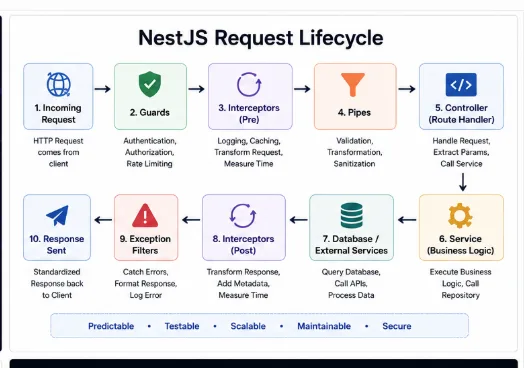
Internal Request Execution Flow Lifecycle
Understanding the journey a request takes through the framework is essential for diagnosing latency spikes and tracking system exceptions accurately. The sequence below outlines the step-by-step path of an incoming client interaction.
Processing Stream Analysis
The execution pipeline acts as a series of specialized data filters. By catching bad formatting, invalid tokens, and unauthorized requests early at the perimeter, the system ensures your core application services and backend databases only spend compute cycles processing high-value, validated business transactions.
Operational Characteristics: Quantitative System Profiles
Managing a high-throughput REST infrastructure requires tracking explicit operational metrics across your production clusters.
Latency Profiles and Serialization Performance
Under normal production conditions, NestJS adds a minimal framework routing overhead of less than 2ms per request compared to bare-metal Node.js engines. By pairing the framework with Fastify as your primary underlying HTTP driver instead of Express, you can boost JSON payload serialization speeds by up to 2 times. This optimization keeps your base infrastructure latency exceptionally low, allowing you to deliver sub-30ms response times for standard read paths under heavy multi-tenant traffic.
Auto-Scaling Dynamics and Compute Footprints
Because NestJS applications rely on highly organized, modular structures, they map perfectly to modern container environments like Kubernetes. Individual microservices or high-volume gateways can be packaged into small container images that maintain a predictable idle memory footprint of roughly 90MB to 130MB.
When user traffic spikes, you can use horizontal auto-scaling rules to spin up fresh container instances in under 150ms, allowing your cluster to scale smoothly in response to real-time resource demands.
[ Traditional Heavy Monolith VM ] --> Slow to boot, expensive vertical scaling
  vs.
[ Decoupled NestJS Container ]    --> Sub-150ms boot times, agile horizontal auto-scaling
System Reliability and Memory Lifecycles
The framework's default singleton design ensures that memory allocation remains stable and predictable throughout the application lifecycle. By instantiating core services once at boot time, the runtime prevents frequent memory allocation and deallocation cycles, minimizing garbage collection pauses.
If a specific request encounters an unhandled error, your configured exception filters catch it instantly, isolating the failure to that single request execution thread and keeping the broader application completely stable for all other users.
Head-to-Head Architectural Comparison Matrix
Choosing the right framework architecture requires evaluating how different design patterns handle control, speed, and long-term system maintainability.
| Architectural Vector | Bare-Metal Node.js (Express) | Scalable NestJS Architecture | Serverless FaaS (AWS Lambda) |
| Architectural Design | Tightly coupled, loose middleware chains | Modul-driven, strict IoC encapsulation | Event-triggered single function blocks |
| Infrastructure Control | Total (Manual server management) | High (Granular design control) | Low (Completely managed cloud fabric) |
| Development Flexibility | Absolute (No structural rules or limits) | Structured (Enforced design patterns) | Variable (Bound to provider environments) |
| Execution Performance | Fast (Minimal runtime abstraction) | Fast (Optimized when paired with Fastify) | Variable (Prone to cold-start delays) |
| System Resiliency | Fragile (Uncaught bugs can crash server) | High (Built-in exception boundaries) | High (Managed auto-recovery loops) |
| Horizontal Scalability | Low (Requires complex custom setups) | High (Scales smoothly in container pods) | Infinite (Automatic, per-request scaling) |
| System Complexity | Low early on; extremely high over time | Medium (Requires learning framework patterns) | Very High (Complex state management) |
| Best Production Fit | Small, single-file scripts; rapid MVPs | High-throughput apps, enterprise backends | Asynchronous workers, background jobs |
| Worst Production Fit | Distributed multi-team enterprise suites | Basic web micro-sites, simple static APIs | Real-time, ultra-low-latency APIs |
Framework Ecosystem Analysis
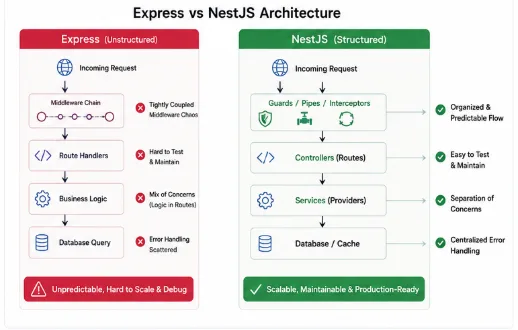
Building a scalable application stack requires evaluating where different backend technologies fit best within your enterprise platform ecosystem.
| Runtime Framework | Primary Purpose | Architectural Strengths | Operational Weaknesses | Learning Curve | Recommended Team Size |
| NestJS (TypeScript) | Enterprise Core REST APIs | Out-of-the-box dependency injection; strict, predictable modular design rules. | Higher initial bootstrap time and compilation overhead. | Medium | 5 to 50+ Developers |
| Fastify (Node.js) | High-Velocity Micro-Services | Exceptionally low overhead; ultra-fast JSON parsing and routing. | Lacks built-in structures for organizing large, multi-team codebases. | Low | 2 to 6 Developers |
| Spring Boot (Java) | Heavy Transactional Backends | Massive enterprise ecosystem; highly mature database pooling tools. | Heavy memory usage; slower cold-start times in container setups. | High | 10 to 100+ Developers |
| Go-Kit (Golang) | Ultra-Low Latency Streaming APIs | Tiny memory footprint; incredible raw execution and concurrency speeds. | Requires writing verbose, complex boilerplate code for simple operations. | High | 3 to 10 Expert Engineers |
Enterprise Framework Strategy
-
Select NestJS as your standard framework for primary core business platforms and complex enterprise REST APIs. Its strict patterns and dependency injection architecture ensure large, multi-team codebases remain clean, organized, and maintainable as your product grows.
-
Select Fastify directly when building lightweight edge utilities, low-level reverse proxies, or simple microservices that only need to route payloads quickly without processing complex business logic.
-
Select Go-Kit for specialized, high-frequency computing nodes—such as low-level network streaming or massive real-time data ingestion pipelines—where keeping memory footprints minimal and raw execution speeds maxed out is your highest priority.
Demystifying Common Architectural Misconceptions
When adopting an advanced backend framework like NestJS, it is easy to run into common engineering myths that can lead to poor design decisions if not clearly understood.
Misconception: NestJS is just an Angular clone for the backend
Many developers look at the TypeScript decorators, modules, and dependency injection patterns in NestJS and assume it is simply a port of the Angular frontend framework to server environments. While NestJS was inspired by Angular's clean structural design, it is a completely independent server-side framework built to solve backend problems like request-response sandboxing, database resource management, and asynchronous microservice streaming.
Misconception: The framework introduces too much execution latency
A common myth among node developers is that the framework's abstractions and dependency graphs introduce significant execution lag compared to raw Express setups. In reality, once the dependency graph is resolved at boot time, the framework's internal routing overhead is negligible. When paired with Fastify, NestJS consistently out-performs traditional Express apps, proving that clean architecture does not have to come at the expense of performance.
Misconception: Dependency Injection is unnecessary in JavaScript applications
Developers used to writing loose JavaScript often argue that formal Dependency Injection patterns are an over-engineered pattern borrowed from Java that isn't needed in flexible scripting environments. This view overlooks the challenges of scaling large enterprise apps. Without dependency injection, mocking complex infrastructure components (like external payment gateways or live database pools) during testing requires messy, fragile hack scripts that slow down development and introduce bugs.
Misconception: Every service provider should be shared globally
When discovering the convenience of shared modules, teams frequently fall into the trap of marking every new service provider as a global component. Making everything global undermines the value of modular design, turning your application into a tangled web of hidden dependencies where changing code in one module can cause unexpected failures in completely unrelated features.
Misconception: You must use a heavy database ORM like TypeORM or Prisma
There is a widespread belief that NestJS requires using heavy database ORMs to handle your storage layer. While the framework integrates cleanly with popular ORMs, you are never locked into a specific database client. For high-volume endpoints where ORM abstraction overhead slows down queries, you can easily inject raw database drivers like pg or use lightweight query builders like Knex.js to interact with your storage clusters directly.
Hard Engineering Rules: When to Transition Your Stack
Migrating your infrastructure to a highly structured architecture is a major strategic decision. Use these practical engineering guidelines to determine if the transition is right for your product.
When You Should Build This Architecture
-
Multi-Team Enterprise Codebases: Your development team has grown past ten engineers, and developers are constantly blocking each other with git merge conflicts because everyone is modifying the same unstructured application files.
-
Long-Term Product Platforms: You are building a core business platform expected to scale and be maintained for years, requiring bulletproof test suites, predictable structures, and clear migration paths.
-
Complex Internal Resource Dependencies: Your endpoints manage intricate combinations of internal resources, requiring advanced request-response features like automated validation pipes, security guards, and data serialization filters.
When to Avoid This Architecture
-
Early-Stage Interactive MVPs: You are a solo developer working to launch a simple landing page or basic prototype in a few days to test a market idea, where finding immediate product-market fit matters far more than long-term code organization.
-
Simple Data-Forwarding Proxies: Your application operates purely as a simple proxy that passes payloads along to another service without running complex business calculations or managing user validation rules.
-
Serverless-First Edge Functions: Your entire infrastructure is built on tiny, ephemeral edge runtimes (like Cloudflare Workers or AWS Lambda), where minimizing initial deployment package sizes and cold-start times is critical.
Enterprise Architecture Recommendation Matrix
Matching your specific business challenges to proven design patterns prevents you from over-engineering early on while ensuring your core systems are always ready to scale.
| Concrete Business Challenge | Recommended System Architecture | Technical Rationale | Core Implementation Risk |
| Rapid engineering growth is causing code quality to drop and merge blocks to rise. | Encapsulated Domain Modules with strict API contracts. | Restricts feature dependencies and isolates code changes, letting separate product teams deploy features independently. | Can increase initial development times due to strict interface rules. |
| Raw database errors are leaking to client logs, creating security exposures. | Global Exception Interception and Filtering fabric. | Standardizes all application errors at the perimeter, keeping internal system details safe from the public. | Poorly configured catch-all rules run the risk of silencing critical system alerts. |
| High-volume data endpoints are slowing down due to object allocation overhead. | Hardened Fastify Core Engine with Singleton Providers. | Minimizes framework serialization lag and cuts garbage collection times down under heavy traffic. | Requires careful code reviews to ensure transient states aren't saved inside singletons. |
Enterprise Decision Framework
Use the evaluation matrix below to determine if your platform should adopt a highly structured architecture like NestJS or maintain a lightweight modular monolith design.
Structural Evaluation Matrix
Rate your current system requirements from 1 (Lowest Priority) to 5 (Absolute Requirement):
[ Strategic Infrastructure Metric ]        [ Value Score: 1 to 5 ]
1. Needed Request Predictability            (  )
2. Long-Term Code Maintainability           (  )
3. Target Performance SLA Boundaries        (  )
4. Multi-Team Deployment Independence       (  )
5. Needed Input Validation Rigor           (  )
6. System Security Perimeter Isolation      (  )
7. Mock Testing Simplicity Requirements     (  )

TOTAL STRATEGIC ARCHITECTURE SCORE:         [  ]
Strategic Scoring Framework
-
Score between 7 and 17: Deploy a Lightweight Fastify/Express Stack. Your application demands are simple enough that the structural abstractions of a large framework will add unnecessary development friction. Focus on keeping your project files clean and organized using basic directory conventions.
-
Score between 18 and 26: Adopt a Hardened Hybrid Architecture. Keep your primary web setup lightweight, but start migrating your most complex business modules and high-volume endpoints to structured, decoupled patterns to protect your event loop.
-
Score between 27 and 35: Transition to a Full NestJS Architecture. Your platform requires strict code organization, absolute test reliability, and resilient perimeter security. Moving to a highly structured framework is essential to keep your engineering velocity high and your infrastructure stable as your business grows.
Real-World Enterprise Case Studies
Analyzing how major engineering teams navigate large-scale architectural transitions provides valuable lessons for designing your own systems.
Case Study 1: Financial Gateway Replaces Loose Middleware Stack
-
The Business Problem: A high-growth payment processor struggled with frequent partial outages during peak shopping hours. Their legacy Express backend relied on loose, uncoordinated middleware chains that frequently dropped database connections, resulting in corrupted payment transaction logs.
-
The Challenges: The codebase lacked a clear structure, making it incredibly difficult to write automated unit tests or safely deploy updates without risking breaking changes across unrelated features.
-
The Architecture: The team rewrote their core platform using a highly structured NestJS architecture. They introduced strict security guards to validate incoming request tokens at the perimeter, and packaged their transactional logic into isolated domain modules.
-
The Results: The modular design completely eliminated cascading database crashes. The team achieved a 99.99% successful transaction rate during peak loads, and automated test coverage jumped from 12% to over 85% within six months.
Case Study 2: Media Streaming Platform Automates Payload Sanitization
-
The Business Problem: A digital streaming platform discovered that their legacy API was accidentally leaking internal user tracking metrics and server routing IDs within public JSON response payloads, creating a significant security vulnerability.
-
The Challenges: The platform's controllers were heavily tangled with custom data-cleansing code, making it nearly impossible to update their security rules without refactoring hundreds of individual route files.
-
The Architecture: They deployed a global NestJS Interceptor fabric across their entire API cluster. This interceptor automatically reads custom route metadata tags and strips out sensitive internal database properties before any data is sent down the wire.
-
The Results: The global interceptor layer successfully removed all internal keys from public endpoints without requiring any changes to their underlying domain services. This centralized update secured their public data contracts instantly and saved their development team weeks of manual refactoring.
Distributed Production Pitfalls: Prevention and Recovery
Operating high-throughput systems in production introduces unique performance traps that you must actively design against to keep your clusters stable.
Memory Leaks from Unmanaged Request Scopes
A common production failure occurs when developers configure core services or database repositories using transient request scopes (Scope.REQUEST). While this lets you track specific user data inside the service instance easily, it forces the Node.js runtime to create a fresh object allocation for every single incoming request. Under high traffic, this rapidly exhausts available memory and triggers aggressive garbage collection pauses that slow your API to a crawl.
[ Request Scope Enabled ]  ── Fresh Object Per Request ──► [ GC Exhaustion ] ──► System Lag
  vs.
[ Default Singleton Scope ] ── Single Shared Instance  ──► [ Stable Memory ]  ──► Sub-30ms Responses
How to Prevent This: Always use the default singleton provider scope for your services and utilities. If you need to track user identities or session tokens across execution threads, pass that context data explicitly through function parameters rather than storing it inside the state of the class instance itself.
Circular Dependency Compilation Crashes
As modular applications expand, developers frequently fall into the trap of importing Module A into Module B, while simultaneously importing Module B back into Module A to access a shared service. This creates an unresolvable loop in the framework's dependency tree, causing the application compiler to crash during deployment initialization.
How to Prevent This: Always extract shared utilities, database models, and common helper classes out of your main feature modules and place them into a dedicated, low-level SharedModule or CommonModule. This creates a clean, one-way dependency flow across your codebase and prevents circular compilation loops entirely.
Enterprise Production Best Practices Checklist
To ensure your structured NestJS applications remain fast, secure, and easy to maintain under heavy production workloads, enforce the following engineering standards across your team:
Architecture & Modular Standards
-
Enforce strict encapsulation by ensuring no module reads or modifies the private providers of another module without explicitly declaring them in the shared exports array.
-
Keep all controller classes highly lightweight, restricting their responsibilities to simple input validation and routing before handing data off to the domain service tier.
-
Avoid the use of request-scoped providers across your core application services to protect your infrastructure from high garbage collection overhead.
Security & Perimeter Controls
-
Deploy a robust catch-all exception filter at the application edge to format unhandled errors into standard JSON responses and keep internal database paths safe from public view.
-
Implement strict validation pipes combined with class-validator configurations to sanitize incoming data models and drop unexpected request properties instantly.
-
Use fast, cache-backed lookup systems within your security guards to verify user roles and evaluate rate limits without creating database bottlenecks.
Performance & Observability Infrastructure
-
Connect your REST runtime to Fastify as your primary underlying HTTP engine to maximize payload serialization performance and minimize network latency.
-
Inject unique distributed tracing headers into your execution context metadata to ensure all related logs remain easily searchable across your monitoring dashboards.
-
Use data interceptors to automate common output formatting tasks, ensuring your API always presents a reliable, professional contract to external frontends.
The Future Architectural Outlook
As enterprise systems continue to evolve, several emerging technological shifts are fundamentally changing how we design and build high-performance REST APIs.
Native Compilation and Edge Optimized Runtimes
The JavaScript ecosystem is rapidly moving past standard Node.js runtimes toward faster engine designs like Bun and Deno. These modern runtimes offer out-of-the-box support for TypeScript compilation, built-in optimization layers, and incredibly fast startup speeds.
In the coming years, we will see enterprise frameworks optimizing their dependency injection engines to run directly on these edge runtimes, allowing you to deploy highly structured modular APIs right at the network edge with virtually zero cold-start delay.
The Rise of AI Agent Communication Standards
The dramatic increase in autonomous AI agents working inside enterprise workflows is shifting how we think about API design. Instead of building endpoints purely for human-facing web apps, modern platforms must design their interfaces to be easily understood and navigated by language models. Adopting unified client-server interface standards ensures your microservices can safely expose tools and data contexts to automated AI workflows without creating new security risks or requiring expensive custom integrations.
Architectural Verdict & Summary
Building high-throughput enterprise REST APIs requires moving past loose, unstructured scripts and adopting highly predictable, modular system architectures.
Strategic Takeaways
-
Enforce Structural Predictability: Using Inversion of Control and dependency injection patterns eliminates fragile class-instantiation boilerplate and ensures your codebase remains clean and easy to test as your engineering team scales.
-
Harden Your Application Perimeter: Catching invalid data shapes, unauthorized tokens, and unexpected errors early at the network edge using guards and filters protects your core business logic and keeps your databases running smoothly.
-
Optimize for Singleton Execution: Sticking to singleton provider scopes minimizes object allocation overhead, prevents dangerous memory leaks, and ensures your application delivers stable, ultra-low-latency performance under heavy production traffic.
By leveraging NestJS's modular framework patterns, connecting to fast HTTP drivers like Fastify, and deploying robust data interceptors and exception filters, you can build a highly resilient, enterprise-grade backend infrastructure ready to power your digital platform's long-term growth.